Mission Peak

Fremont, CA – Mission Peak Regional Preserve, East Bay Regional Park

Last updated on January 7th, 2026 at 5:38 pm


Online sign-in

Quick Overview:

Dave Kilbourne first soared Mission Peak in a standard Rogallo wing on September 6, 1971. Mission Peak was then opened as a Wings of Rogallo site for hang gliding in 1983, and is now flown by pilots under a special use agreement with the East Bay Regional Park District. Mission can be flown as a hike and fly site, or driven to launch through a restrictive “keyholder” program.

Telegram

Radio Frequency: 147.405 MHz

Site Committee Chairs: Steve Welch & Bob Posey

[email protected]

Hang gliding: H4 or H3 plus additional requirements
Paragliding: P4 or P3 plus additional requirements
Mini-wings: M1 special skill recommended

Park Information

  • Mission Peak Regional Preserve is open year-round from 6am-10pm
  • The Stanford Avenure Staging Area parking lot is small and is frequently full, even on weekdays; carpooling is encouraged.
  • Limited street parking is available on Vineyard Ave on weekends and holidays. Observe the posted No Parking signs and hours/days of enforcement.
  • Plan to arrive at Mission early in order to account for time to find a parking spot
  • The hike to launch can take about 45 minutes to an hour and a half, pace depending
  • The drive to launch takes about 25 minutes
  • Cattle may be present in the site—do not approach and give them space

Club Rules

  • Current USHPA and WOR (full or visiting) membership
  • Follow all park rules and regulations
  • Follow all FAR part 103 operating requirements
  • Fly with a helmet and an emergency parachute
  • Meet all rating requirements
  • Launch only from a designed launch
  • Land only in a designated LZ unless top landing
  • Call 911 in case of an emergency
  • No commercial activity
  • Report any accidents, incidents or concerns using this form
  • Recommended to fly with a cell phone, radio and satellite tracker

Site Requirements

  • Pilots must sign the Mission Peak Waiver
  • Pilots must sign-in before flying
  • H3/P3s must fly under sponsorship supervision
  • H4/P4s must receive a site intro from a pilot who has significant experience flying at Mission
  • A maximum of 25 gliders are allowed at the launch area at any time
  • A maximum of 45 gliders are allowed on site (within the launch area, landing area, or in process of travel between the launch area and landing area) at any one time

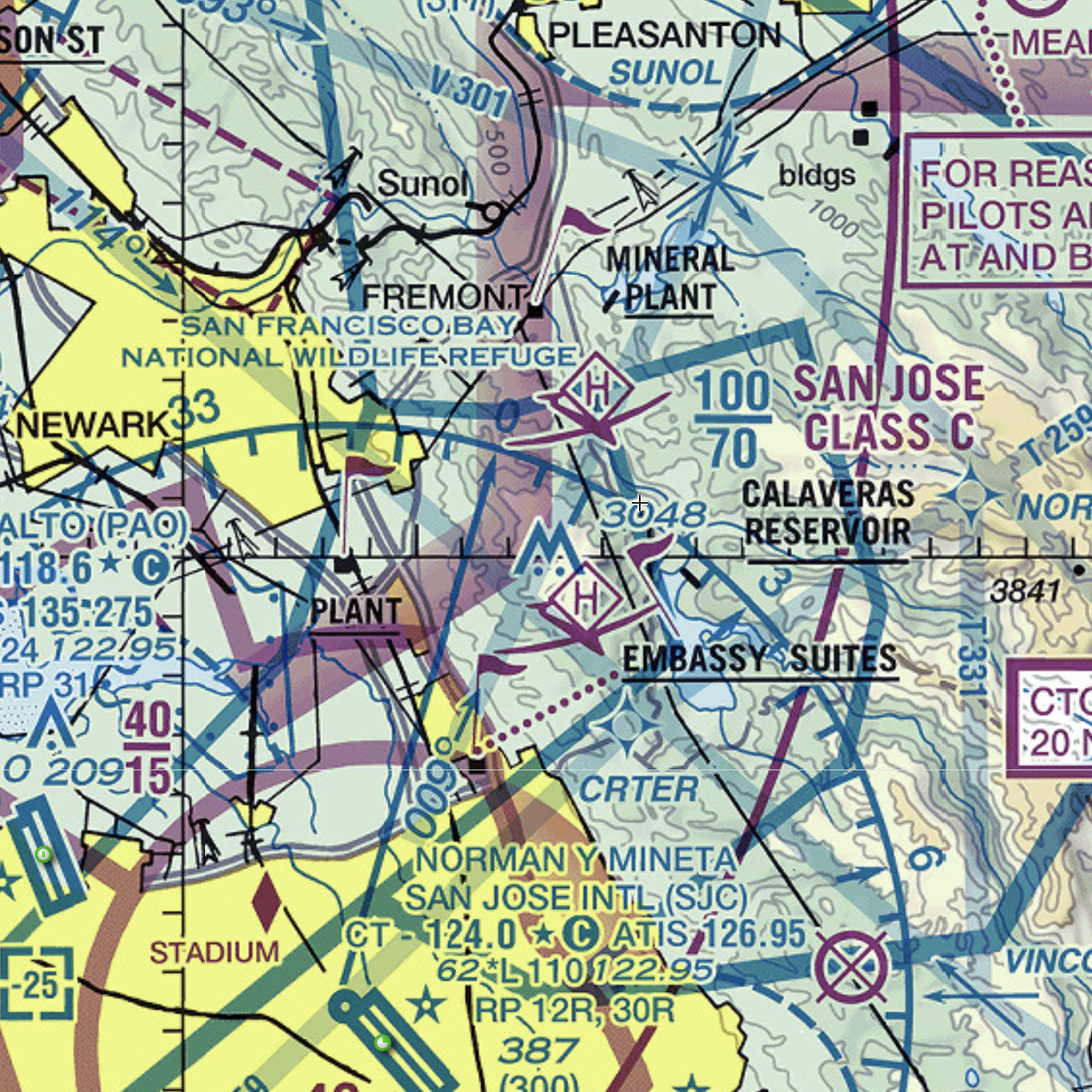
Airspace

  • Maximum altitude over Mission is 6000′
  • Nearby airways have minimum altitudes of 4000′ & 8000′
  • Significant general aviation and helicopter traffic—pilots must see-and-avoid and follow FAR 103 yielding rules
  • It is recommended to fly with an instrument that displays airspace info

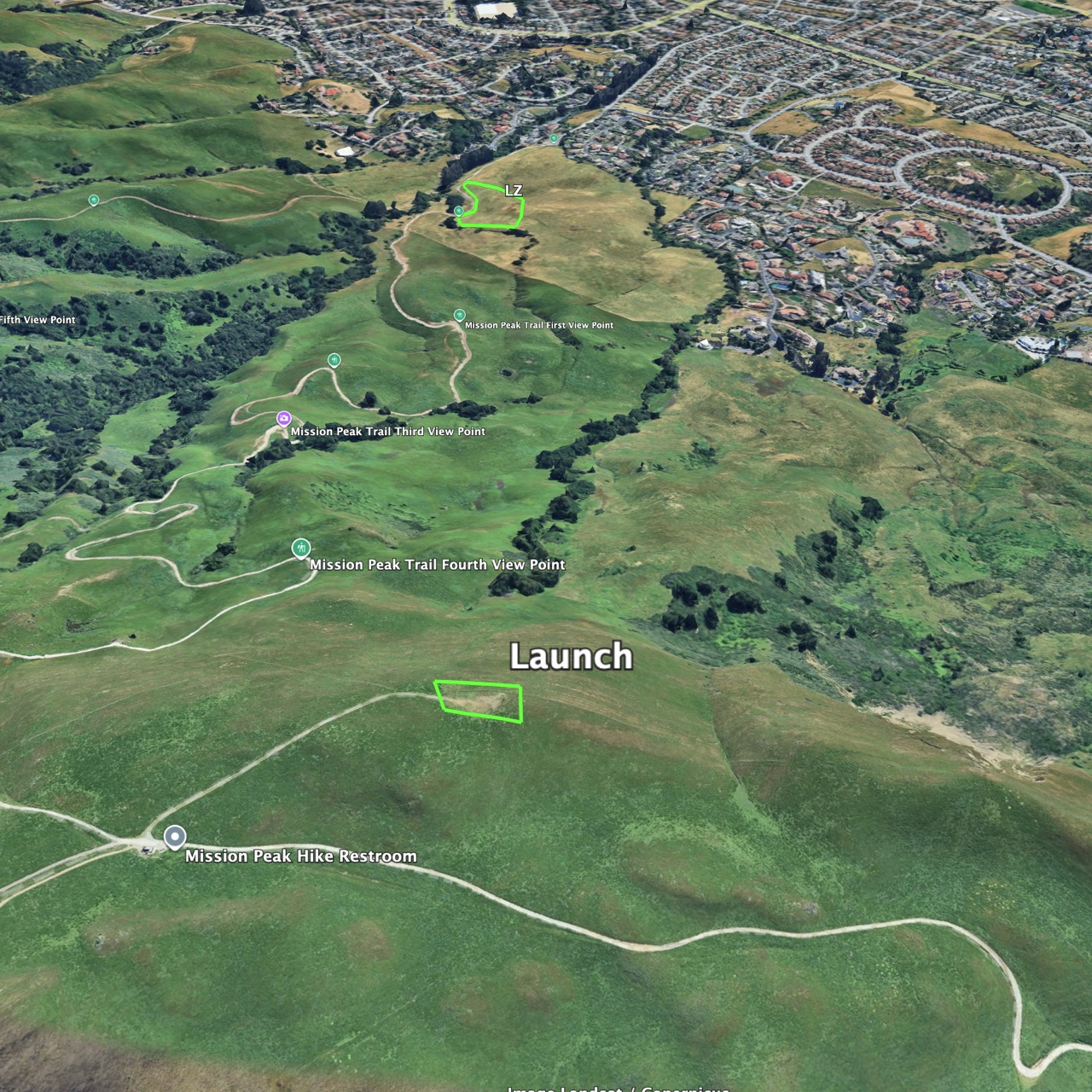
Launch

Winds: NW-SW

HG: 0-25mph, ideal 15mpg

PG:0-20mph, ideal 8mph

Glide ratio: 4:1

  • Paragliders are encouraged to launch lower down the hill in strong winds

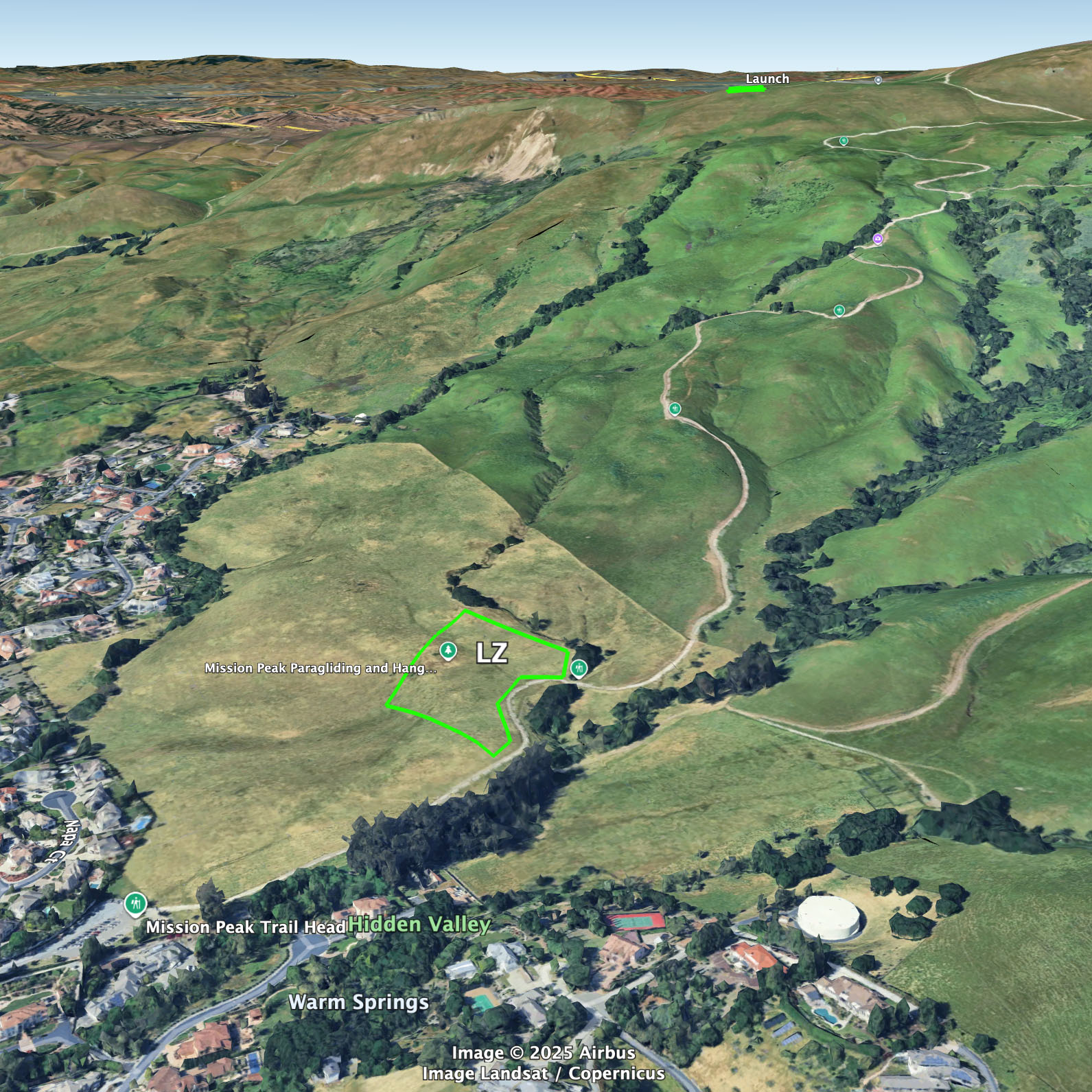
Landing Zone (LZ)

  • Large, flat, obstacle-free; usable for all launches
  • Frequent hikers in the vicinity of the LZ
  • Wind varies—common direction is NW
  • Be cautious of rotor behind trees when wind is south
  • Uneven terrain in the LZ which slopes down toward the parking lot past the LZ
  • Obstacles (trees) on the approach end of the LZ
  • LZ is a thermal trigger and dust devils along the trail are common, especially in summer

Top Landing

  • Allowed at launch if the launch area is clear

Packing

  • Clear the “preferred” LZ area immediately after landing to make room for other pilots
  • Paragliders typically pack up area is between the hiking trails to avoid foxtails and star thistles
  • Hang gliders typically carry assembled gliders to the gate and break down near the gate, before loading gliders to cars in the parking lot

Site Intros for P3/H3 Pilots

In addition to meeting the requirements outlined in the Site Procedures, H3/P3 pilots must meet the following requirements to fly at Mission:

  • Pilots must possess basic thermal and mountain flying skills, be proficient in flying in active conditions, and be able to land in restricted areas before being sponsored to fly at Mission
  • Pilots must describe their thermal and mountain flying experience to their sponsor before flying at Mission
  • As a guideline, pilots should have flown a minimum of 4 mountain flights from launches over 2800′ MSL, each over 20 minutes duration in thermal lift per flight, before flying at Mission
  • Pilots must complete at least three flights under the supervision of a member of the Mission Peak Site Introduction Team on the same wing type. At least one of those flights must be a sustained flight under thermic conditions (i.e. not during late evening conditions when there is only ridge lift, or when there is no lift)
  • The sponsored flight will only count if it is conducted safely and in compliance with the site procedures. It must include a safe controlled launch and landing in the designated landing zone
  • The sponsor has the authority to determine whether the sponsored flight has met the requirements described above
  • The sponsor may also decide that only two supervised flights are required, if the pilot is exceptionally skilled and experienced, or that more than three supervised flights are warranted.
  • H3 pilots must have completed their H4 spot landing requirements.

Pilots can request an introduction from approved sponsors by:

When requesting sponsorship:

  • Pilots are asked to try to request an introduction at least 24h before flying, in order to help sponsors coordinate plans.  Last-minute requests are OK, and are at the sponsor’s discretion, but may not be accommodated depending on sponsor availability and capacity
  • Sponsored pilots are expected to be fully prepared with knowledge of the site procedures. Pilots may be asked questions about the procedures and will be expected to demonstrate knowledge for the introduction to be counted towards their sponsored flights

Site Intro Team

You must be on the Mission Site Intro Team to sponsor H3/P3 pilots

  • Before sponsoring any pilots, shadow at least one intro by another member of the Site Introduction Team of the same wing type
  • Brief pilots on all of the topics from this site procedures page
  • Once a pilot has completed their final sponsored flight, post to the Mission Site Intro Committee telegram group and an admin will enable the pilot’s silver Mission icon on their electronic membership card. Include the pilot’s name and USHPA number in the email
  • If there are any major concerns with any sponsored pilots, please report those concerns to the site chars [email protected]

Privileges may be revoked for failure to meet responsibilities.

Paragliding Sponsors

  • Dietmar Burkhardt Jr USHPA #57395
  • Evan Cohen USHPA #88630
  • George Du USHPA #100559
  • Daniel Fourie USHPA #97550
  • Alexander Honda USHPA #99786
  • Dmitrii Khairullin USHPA #105204
  • Kenneth Kim USHPA #101746
  • Jason Lauritzen USHPA #100281
  • Jennifer Lauritzen USHPA #100283
  • Jesse Meyer USHPA #83606
  • Dominic Montagu USHPA #104449
  • Ben Pedersen-Wedlock USHPA #97368
  • Enrique Perez Smutny USHPA #102111
  • Robert Posey USHPA #84727
  • Jacob Rendina USHPA #104365
  • Julie Spiegler USHPA #54168
  • Michael Vergalla USHPA #92026
  • Steven Welch USHPA #91725
  • Daniel Zaslavsky USHPA #97516

Hang Gliding Sponsors

  • James Bowe USHPA #84977
  • Paul Clayton USHPA #41958
  • Takeo Eda USHPA #93987
  • Soham Mehta USHPA #95973
  • Michael Soderstrom USHPA #79621
  • Roy Spencer USHPA #45805
  • Anthony Tagliaferro USHPA #87955

Weather Information

  • Mission is often flyable from March to mid-September
  • The typical daily weather pattern for Mission under benign conditions is for light and variable conditions to be present in the morning, thermic conditions to be present mid-day, and for a stable sea breeze to be present by mid to late afternoon, producing a mixture of ridge lift and thermal lift
  • During the Summer months, there is typically an inversion at Mission providing limited top of lift, and creating turbulence at the top of the boundary layer

Vehicle Access

Gate Locks

  • You must be a key holder to unlock the gate use the back road to drive to launch. The application to become a key holder can be found here
  • Locks must be closed immediately after passing

Vehicle Rules

  • A key holder is allowed road access to launch by the registered vehicle and cannot be used by any non-registered vehicle
  • Valid driver’s license + CA-compliant insurance required
  • Carpool when possible
  • Obey all posted speed limit
  • Yield to hikers
  • The number of Licensee vehicles in the Stanford Avenue Staging Area will be limited to not more than 20 at any single time.
  • The total number of vehicle round trips to the launch area will be limited to 19 per day
  • The total number of Licensee’s and Licensee’s members’ vehicles inside the park (inside the park gate) shall not exceed 10 vehicles at any one time.

Road Conditions

  • The back road to launch will close for five days after a heavy rain and three days after a light rain